
What causes Scoliosis: Types,causes and Risk Factors
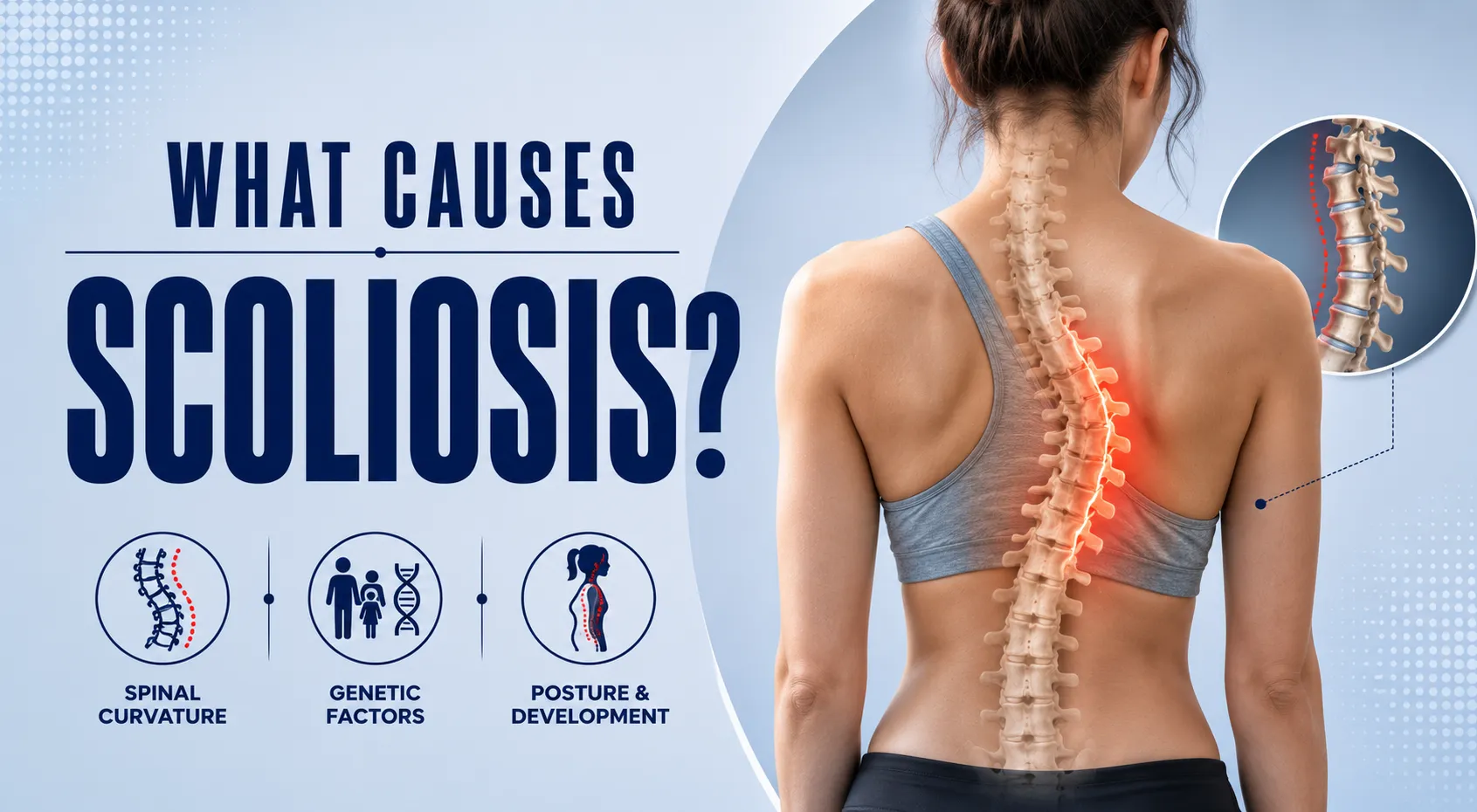

Scoliosis is a three-dimensional deformity of the spine, characterised by a sideways curvature together with rotation of the vertebrae.
Mild scoliosis may cause few or no symptoms. Larger curves can cause visible changes in posture and, in some cases, may be associated with pain, reduced function or breathing difficulties.
One of the most common questions patients ask is, “What causes scoliosis?” The answer depends on the type of scoliosis. In many cases, particularly among adolescents, the exact cause is unknown. However, scoliosis can also develop due to congenital abnormalities, neuromuscular conditions, age-related degeneration, or other underlying medical problems.
This guide explains the causes of scoliosis, the different types of the condition, associated risk factors, symptoms, diagnosis, treatment options, and when to seek medical advice.
What Is Scoliosis?
Scoliosis is defined radiographically as a spinal curvature with a Cobb angle of 10 degrees or more. It is a three-dimensional condition that also involves vertebral rotation.
The condition may affect:
- The upper back (thoracic spine)
- The lower back (lumbar spine)
- Both regions
The likelihood of progression depends on several factors, including the type of scoliosis, curve magnitude, skeletal maturity and remaining growth.
What Causes Scoliosis?
Scoliosis has several possible causes.
The main types include:
- Idiopathic scoliosis
- Congenital scoliosis
- Neuromuscular scoliosis
- Degenerative scoliosis
- Syndromic scoliosis
- Functional scoliosis
Each has different underlying mechanisms and treatment considerations.
1. Idiopathic Scoliosis
Idiopathic scoliosis is the most common form, accounting for around 80% of cases.
The exact cause remains unknown, although genetic and biological factors are thought to contribute. Adolescent idiopathic scoliosis is considered a complex, multifactorial condition.
Adolescent idiopathic scoliosis typically becomes apparent during the growth spurt around puberty.
2. Congenital Scoliosis
Congenital scoliosis results from abnormalities in vertebral development before birth, although the spinal curvature may not always be apparent at birth.
The vertebrae may:
Fail to form completely
Be fused together
Develop abnormally
The severity varies considerably between individuals.
3. Neuromuscular Scoliosis
Neuromuscular scoliosis can develop in people with neurological or muscular conditions that affect muscle control, tone, strength and balance around the spine.
Examples include:
Cerebral palsy
Muscular dystrophy
Spinal muscular atrophy
Spina bifida
Neuromuscular curves can become large and may progress, although the pattern and risk of progression depend on the underlying condition and the individual’s functional status.
4. Degenerative Scoliosis
Degenerative scoliosis can develop in adulthood as asymmetric degenerative changes affect the discs, facet joints and other spinal structures.. Learn more in Age-Related Changes in Spinal Health. Degenerative disc disease is one of the leading contributors to adult scoliosis. See 4 Stages of Disc Degeneration.
It may result from:
Facet joint degeneration
Osteophyte formation
Loss of disc height
Asymmetric disc degeneration
Symptoms commonly include:
Lower back pain
Stiffness
Leg pain
Difficulty standing or walking
For a detailed look at treatment options, read Treatment for Degenerative Scoliosis.
5. Syndromic Scoliosis
Scoliosis can occur as part of certain genetic or connective-tissue syndromes.
Examples include:
Marfan syndrome
Neurofibromatosis
Ehlers-Danlos syndrome
Management depends on both the spinal curve and the underlying condition.
6. Functional Scoliosis
Functional scoliosis is different from structural scoliosis.
A functional, or non-structural, spinal curve occurs without a fixed structural deformity and may reduce or disappear when the underlying cause or position is corrected.
Muscle spasm
Leg length difference
Pain
Functional scoliosis is different from structural scoliosis and does not usually involve the fixed vertebral rotation seen in structural curves.
Risk Factors
Factors associated with scoliosis or its progression depend on the type. In adolescent idiopathic scoliosis, important factors affecting progression include remaining skeletal growth, curve magnitude and sex. A family history may also increase susceptibility.
What Are the Symptoms of Scoliosis?
Many people have mild scoliosis with few or no symptoms.
Possible symptoms include:
- Uneven shoulders
- One shoulder blade appearing more prominent
- Uneven waistline
- One hip sitting higher than the other
- Back pain
- Muscle fatigue
- Leaning to one side
- Changes in posture
Very large thoracic curves can, in some individuals, affect chest mechanics and pulmonary function.
When Should You Seek Medical Advice?
Arrange an appointment if you notice:
- A visible curve in the spine
- Uneven shoulders or hips
- Persistent back pain
- Progressive changes in posture
- Difficulty walking
- Numbness or weakness in the legs
Children and adolescents with a suspected spinal curve should be assessed, particularly when significant growth remains, because progression is more likely during periods of rapid growth.
How Is Scoliosis Diagnosed?
Assessment usually includes:
Medical History
Your clinician will ask about:
Symptoms
Family history
Previous spinal problems
Growth history (in children)
Physical Examination
This may include:
Observation of posture
Forward bend test
Shoulder and hip alignment
Neurological examination
Imaging
X-rays
Standing X-rays measure the degree of spinal curvature (Cobb angle).
MRI Scan
MRI is not routinely required for every person with scoliosis. It may be recommended when there are neurological abnormalities, atypical curve features, significant pain or other clinical concerns suggesting an underlying spinal or neurological condition.
CT Scan
CT is occasionally used to assess complex spinal anatomy.
Treatment Options
Treatment depends on:
The cause
The degree of curvature
Symptoms
Age
Risk of progression
Observation
Small curves may only require regular monitoring.
Physiotherapy
Physiotherapy may help improve:
Strength
Flexibility
Posture
Pain management
Exercise and physiotherapy can help with strength, function and symptoms. In selected patients, scoliosis-specific exercise programmes may also have a role in conservative management, although they do not replace bracing or surgery when these are indicated.
Bracing
In selected children and adolescents who are still growing, bracing can reduce the risk of curve progression and the likelihood of reaching a surgical threshold.
Pain Management
Adults with degenerative scoliosis may benefit from:
Pain relief medication
Exercise programmes
Activity modification
Physiotherapy
Surgery
Surgery may be considered when
Curves are severe
The curve continues to progress
Pain is significant
Neurological symptoms develop
Very large curves affect cardiopulmonary function in selected cases
The reasons for surgery differ considerably between adolescent, congenital, neuromuscular and adult degenerative scoliosis.
Can Scoliosis Be Prevented?
Most forms of structural scoliosis cannot currently be prevented. In particular, adolescent idiopathic scoliosis is not caused by poor posture, exercise habits or something a child or parent has done.
When Should You See a Spinal Specialist?
A referral to a spinal specialist may be appropriate if:
- The spinal curve is progressing
- Pain persists despite treatment
- Walking becomes difficult
- Numbness or weakness develops
- Surgery is being considered
Early assessment can help determine the most appropriate management plan.
Conclusion
Scoliosis has several possible causes, ranging from idiopathic and congenital conditions to age-related degeneration and neuromuscular disorders. Understanding the underlying cause is important because it influences treatment, monitoring, and long-term outcomes.
Many people with scoliosis live active, fulfilling lives, and not everyone requires surgery. Appropriate assessment and monitoring can help identify curves at risk of progression, manage symptoms and determine when treatment may be beneficial.
If you or your child has been diagnosed with scoliosis, or you have noticed changes in posture, uneven shoulders, or persistent back pain, an assessment by a spinal specialist can help identify the cause and discuss the most appropriate management options.
Disclaimer
This article is for general information only and does not replace professional medical advice. If you have concerns about your symptoms, please consult a qualified healthcare professional.