
When Is Surgery Recommended for Spinal Stenosis?
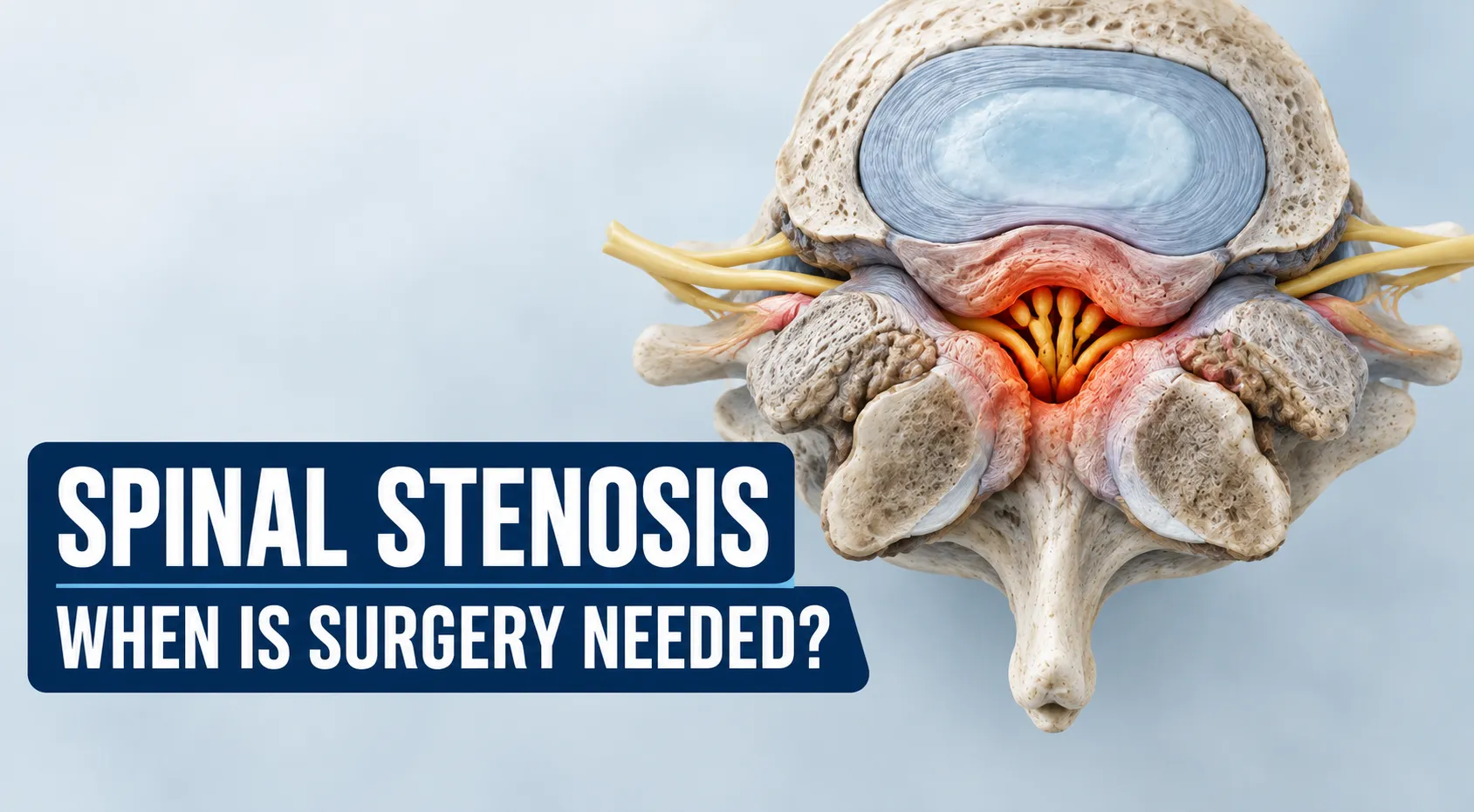

Spinal stenosis occurs when there is narrowing around the spinal canal or the spaces through which spinal nerves pass. In the lower back (lumbar spinal stenosis), this narrowing can sometimes press on the nerves and cause symptoms such as leg pain, numbness, weakness, or difficulty walking.
A diagnosis of spinal stenosis does not automatically mean that surgery is required.
Many people with spinal stenosis can initially be managed without an operation. Surgery is generally considered when symptoms persist or significantly affect quality of life and when the potential benefits outweigh the risks.
The decision depends on several factors, including symptoms, their impact on daily activities, examination findings, imaging results, and how they have responded to non-surgical treatment.
What Is Spinal Stenosis?
Spinal stenosis refers to narrowing of spaces within or around the spine.
In lumbar spinal stenosis, narrowing can occur around the spinal canal or nerve roots in the lower back. This can reduce the available space for the nerves.
The narrowing may develop for different reasons, including age-related changes involving the discs, facet joints, ligaments and vertebrae.
Some people have spinal stenosis visible on an MRI or other scan without experiencing significant symptoms.
This is why the scan alone does not determine whether surgery is needed.
A surgeon considers the imaging findings alongside the patient’s symptoms and clinical examination.
What Symptoms Can Spinal Stenosis Cause?
Lumbar spinal stenosis can cause a range of symptoms.
These may include:
- Lower back pain
- Pain travelling into one or both legs
- Numbness or tingling in the legs
- Weakness in the legs
- Aching or heaviness in the legs when standing or walking
- Reduced walking distance
- Symptoms that improve when sitting or bending forwards
A common pattern is neurogenic claudication, where standing or walking brings on pain, heaviness, weakness, or other symptoms in the legs that improve with sitting or changing position.
Not everyone with spinal stenosis experiences this pattern.
Does Spinal Stenosis Always Need Surgery?
No.
The presence of spinal stenosis on an imaging scan does not automatically mean that an operation is necessary.
If symptoms are mild or manageable, treatment may initially focus on non-surgical approaches.
Depending on the individual circumstances, this can include:
- Remaining appropriately active
- Physiotherapy or exercise-based rehabilitation
- Pain management
- Modifying activities that aggravate symptoms
- Other non-surgical treatments recommended following assessment
The response to these measures can help inform decisions about whether further treatment is required.
When Is Surgery Considered for Spinal Stenosis?
Surgery may be considered when spinal stenosis is causing significant symptoms that are not adequately controlled with non-surgical treatment.
Factors that can influence the decision include:
Persistent Symptoms
If symptoms continue despite an appropriate period of non-surgical treatment, a spinal specialist may discuss surgical options.
Persistent symptoms do not automatically mean that surgery is required. The type, severity and impact of symptoms are important.
Significant Walking Limitation
Difficulty walking or a substantial reduction in walking distance can be an important consideration, particularly when symptoms are caused by nerve compression.
Someone who previously walked comfortably but now has to stop frequently because of leg pain, heaviness or weakness may require further assessment.
Pain That Significantly Affects Daily Life
Surgery may be discussed when spinal stenosis symptoms interfere substantially with:
Walking
Working
Shopping
Household activities
Exercise
Sleep
Social activities
General independence
The impact of symptoms on a person’s life is an important part of treatment decision-making.
Neurological Symptoms
Numbness or weakness associated with nerve compression can be relevant when considering surgery.
Progressive neurological problems require particular attention.
The urgency and appropriate treatment depend on the specific neurological findings and underlying cause.
Does Severe Spinal Stenosis on an MRI Mean You Need Surgery?
Not necessarily.
MRI can show the degree and location of spinal canal or nerve compression, but imaging findings must be interpreted alongside the clinical picture.
A person may have significant narrowing on an MRI but relatively few symptoms.
Conversely, symptoms can be substantial even when the imaging findings do not appear dramatic.
The key question is whether the imaging findings match the person’s symptoms and exam.
What Happens Before Surgery Is Recommended?
A spinal surgeon will generally assess several aspects of the condition before recommending an operation.
This can include:
Medical History
The surgeon will ask about:
The type of symptoms
When they began
How symptoms have changed
What makes them better or worse
Walking tolerance
Previous treatments
Other health conditions
Previous spinal surgery, where relevant
Physical Examination
The examination may include assessment of:
Leg strength
Sensation
Reflexes
Walking pattern
Spinal movement
Other neurological findings
Imaging
Imaging such as an MRI can help identify the location and extent of spinal narrowing and whether there is compression of relevant neural structures.
Other imaging may be appropriate in particular circumstances.
Response to Non-Surgical Treatment
The response to previous treatment is also important.
A surgeon will want to understand whether symptoms have improved with approaches such as physiotherapy, activity modification or medication where appropriate.
How Long Should You Try Non-Surgical Treatment Before Surgery?
There is no single period that applies to every patient.
The appropriate duration depends on factors such as:
- Severity of symptoms
- Duration of symptoms
- Neurological findings
- Functional limitations
- Underlying spinal pathology
- Response to previous treatment
- Overall health
Someone with manageable symptoms may continue with non-surgical treatment, while someone with significant or progressive neurological problems may require earlier specialist assessment.
Therefore, the decision should not be based on an arbitrary number of weeks or months alone.
What Surgery Is Used for Spinal Stenosis?
The surgical procedure depends on the cause and location of the narrowing and whether there are other structural problems affecting the spine.
One commonly used approach is decompression surgery.
Lumbar Decompression
The objective of decompression is to create more space for compressed neural structures.
Depending on the patient’s anatomy, this may involve removing or modifying structures contributing to the narrowing.
The exact technique varies between patients.
Laminectomy
A laminectomy involves removing part or all of the lamina, a portion of the vertebral arch, to help relieve pressure within the spinal canal.
Whether a laminectomy is appropriate depends on the individual anatomy and surgical objective.
Spinal Fusion
In some patients, decompression may be combined with spinal fusion.
Fusion may be considered when there is an additional problem affecting spinal stability or another clinical reason for stabilisation.
It is not automatically required for everyone with spinal stenosis.
The decision depends on the individual’s spinal anatomy, symptoms and diagnosis.
Is Spinal Stenosis Surgery Always Successful?
No, surgery cannot guarantee a particular outcome.
The potential benefit of surgery depends on factors including:
- The cause of symptoms
- The location of nerve compression
- Duration and severity of symptoms
- Presence of neurological problems
- General health
- The specific procedure performed
It is also important to understand which symptoms are likely to respond to decompression.
For example, symptoms caused by nerve compression may respond differently from longstanding mechanical back pain arising from other spinal structures.
Your surgeon should explain the expected benefits and limitations of the proposed procedure before surgery.
What Are the Risks of Spinal Stenosis Surgery?
Spinal surgery carries risks, as does any operation.
Potential complications vary depending on the procedure and individual circumstances.
These can include:
- Infection
- Bleeding
- Nerve injury
- Cerebrospinal fluid leakage
- Blood clots
- Anaesthetic complications
- Persistent or recurrent symptoms
- Problems related to spinal implants where instrumentation is used
The risk profile varies according to the specific operation.
A spinal surgeon should discuss the relevant risks and potential benefits with you before treatment.
Can Spinal Stenosis Get Worse Without Surgery?
The course of spinal stenosis varies.
Some people experience relatively stable symptoms, while others can develop increasing pain, walking limitation or neurological problems.
Having stenosis on an imaging scan does not mean that deterioration is inevitable.
If symptoms are changing, particularly if weakness or walking difficulty is developing, reassessment is appropriate.
What If Physiotherapy Is Not Helping?
Physiotherapy may help some people manage symptoms and maintain physical function, but it does not remove a structural narrowing of the spinal canal.
If symptoms remain significantly limiting despite appropriate non-surgical management, further assessment may be appropriate.
This does not automatically mean surgery is required.
A spinal specialist can reassess the diagnosis, review imaging, and discuss whether another treatment approach is appropriate.
Can You Avoid Surgery With Exercise?
Exercise can be an important part of managing spinal symptoms and maintaining physical function.
However, exercise cannot be expected to physically reverse established narrowing of the spinal canal.
Rehabilitation may instead aim to maintain mobility, strength, and function, and help a person manage symptoms.
If exercise consistently causes significant leg pain, weakness or other neurological symptoms, the programme should be reviewed by an appropriate healthcare professional.
What Are the Warning Signs That Need Urgent Assessment?
Most people with spinal stenosis do not require emergency surgery.
However, certain symptoms require urgent medical assessment.
These include:
- New loss of bladder or bowel control
- Numbness around the genitals, buttocks or inner thighs
- Rapidly worsening weakness in one or both legs
- Sudden major difficulty walking
- Severe neurological changes
These symptoms can indicate significant nerve compression and should not be ignored.
What Questions Should You Ask Before Spinal Stenosis Surgery?
If surgery has been recommended, it can be useful to ask your surgeon:
Why do I need surgery?
Ask how the symptoms and imaging findings relate to the proposed operation.
What happens if I do not have surgery?
Understanding the alternatives can help you make an informed decision.
What type of operation is being recommended?
Ask whether the procedure involves decompression alone or decompression combined with another procedure.
What symptoms is the surgery expected to improve?
Not every symptom necessarily comes from the same spinal structure.
What are the risks?
Ask about risks specific to your proposed operation and individual circumstances.
What will recovery involve?
Your surgeon can explain the expected recovery based on the actual procedure rather than giving a generic recovery timeframe.
Spinal Stenosis Surgery: The Decision Is Individual
There is no single MRI measurement, symptom or time period that determines whether a person should have spinal stenosis surgery.
The decision is based on the overall clinical picture.
A person with severe-looking stenosis on an MRI but minimal symptoms may not need surgery. Another person with significant walking limitations and persistent nerve-related symptoms may benefit from surgical assessment.
This is why treatment decisions should be made by considering:
- Symptoms
- Clinical examination
- Imaging
- Functional limitations
- Previous treatment
- Overall health
- The potential benefits and risks of surgery
Conclusion
Spinal stenosis does not automatically require surgery.
For many people, initial treatment involves non-surgical approaches aimed at managing symptoms and maintaining physical function. Surgery may become an option when symptoms remain significantly limiting despite appropriate treatment, particularly when nerve-related leg symptoms, walking difficulties or neurological problems are present.
The decision should never be based on an MRI report alone. Interpret imaging alongside symptoms and clinical examination.
If surgery is recommended, the type of operation will depend on the location and cause of the narrowing and whether other spinal problems are present.
Understanding why surgery has been recommended, what it aims to achieve, and what alternatives exist can help you make an informed treatment decision.
If spinal stenosis is affecting your walking, causing persistent leg symptoms or significantly limiting your daily activities, Mr Prasad Karpe, Consultant Spinal Surgeon, can assess your symptoms, examination findings and imaging and discuss whether further treatment or surgical intervention is appropriate for your individual circumstances.
Disclaimer
This article is for informational purposes only and does not replace professional medical advice, diagnosis, or treatment. Disability status and treatment recommendations depend on individual medical assessment and symptom severity.