
Degenerative Spine and Desk Jobs: What Does the Evidence Say?
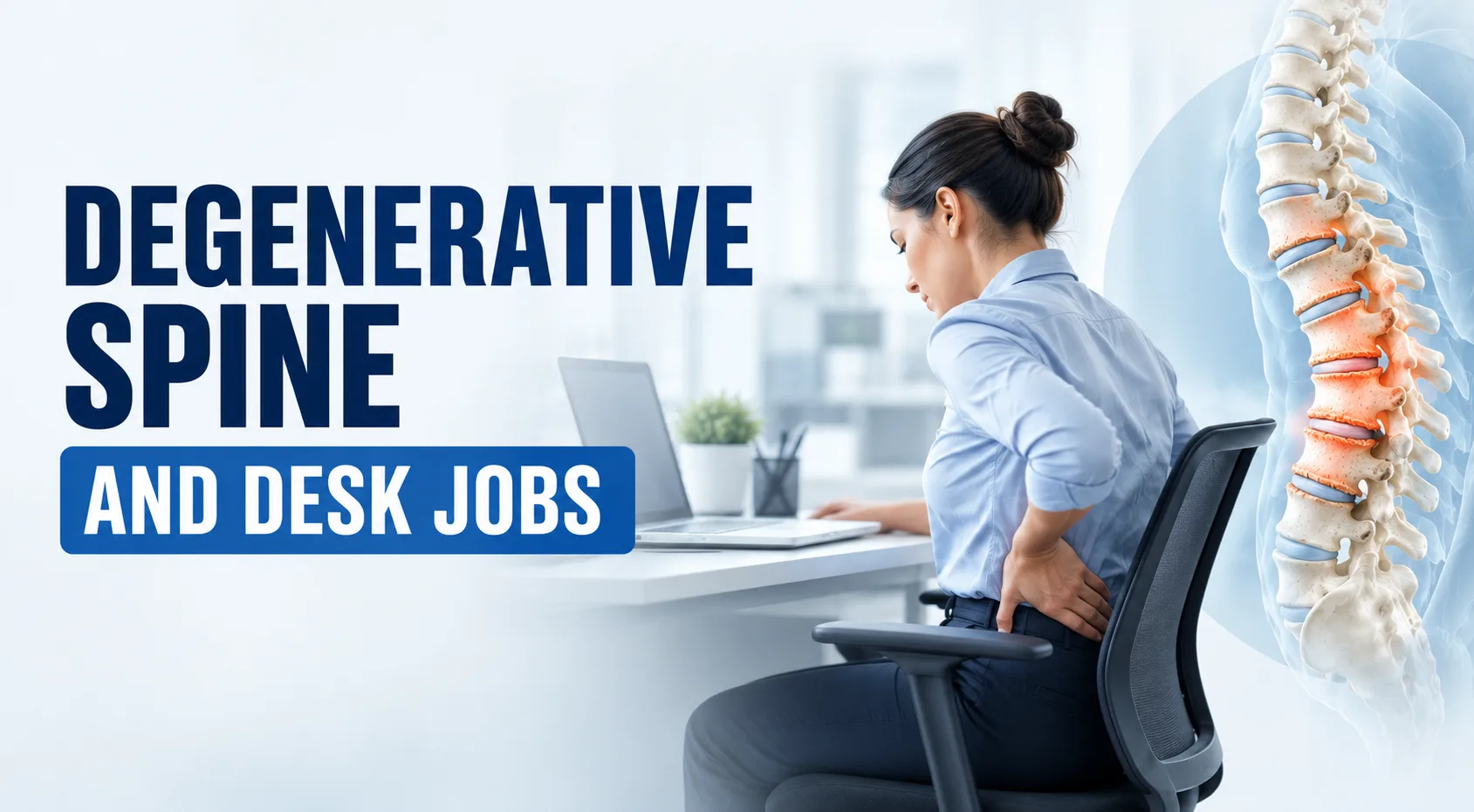

Modern working life often involves spending several hours sitting at a desk, using a computer or attending meetings. Many people experiencing back or neck pain wonder whether their desk job is damaging their spine.
But does prolonged sitting actually cause spinal degeneration, or does it simply make existing symptoms worse?
The answer is not as straightforward as you might think.
What Is Spinal Degeneration?
The spine is made up of vertebrae, discs, joints, ligaments and other supporting tissues. Over time, these structures can change due to ageing and mechanical loading.
These changes may include:
Degenerative disc disease
Disc bulging
Facet joint arthritis
Reduced disc height
Bony changes such as osteophytes
Importantly, these changes do not always cause pain.
A major systematic review by Brinjikji and colleagues found evidence of disc degeneration in approximately 37% of people aged 20 and 96% of people aged 80 who had no symptoms.
Degenerative changes on an MRI are common, even in people without pain. These findings should always be interpreted alongside the patient’s symptoms and clinical examination, rather than being considered in isolation.
Does Prolonged Sitting at a Desk Cause Spinal Degeneration?
There is no simple answer that allows desk work to be labelled as a direct cause of spinal degeneration.
Spinal degeneration is influenced by several factors, including ageing, genetics and individual biological characteristics.
Research into occupational sitting and spinal symptoms is also more complex than the idea that sitting itself directly damages the spine.
A person who works at a desk may spend long periods in one position, with fewer opportunities to move, leading to muscular fatigue or discomfort. These factors can contribute to symptoms, but they should not automatically be interpreted as evidence that sitting is causing structural degeneration.
It is therefore more accurate to focus on prolonged static positions, physical inactivity and workplace habits rather than suggesting that desk work directly causes degenerative spinal disease.
Can a Desk Job Make Back Pain Worse?
For someone who already has back pain, prolonged sitting can sometimes aggravate symptoms.
This does not necessarily mean that sitting is causing further structural damage.
Pain can be influenced by factors such as:
- Remaining in one position for a prolonged period
- Limited movement throughout the working day
- Poorly adjusted workstation equipment
- Repeatedly working in an uncomfortable position
- Reduced physical activity outside working hours
- Stress and fatigue
- Existing spinal or musculoskeletal conditions
People respond differently to sitting. One person may be comfortable working at a desk for several hours, while another may develop significant discomfort much sooner.
Rather than searching for one “perfect” sitting position, it is often more useful to avoid remaining in the same position for too long and to incorporate regular movement into the working day.
What About Poor Posture?
Posture is often presented as a major cause of spinal problems.
However, the relationship between posture and pain is not as straightforward as the idea that one incorrect sitting position damages the spine.
There is no single posture that is guaranteed to prevent back or neck pain.
Instead, spending long periods in the same position can be uncomfortable, particularly when the position is poorly suited to the individual or the workstation.
Changing position regularly and moving throughout the day can be more practical than trying to maintain a rigid “perfect posture” continuously.
Why Movement Matters During a Desk Job
One of the biggest challenges of desk-based work is the amount of time spent physically inactive.
Remaining in the same position for prolonged periods can contribute to muscular fatigue, stiffness and discomfort. Regular movement allows you to change position, reduce prolonged inactivity and maintain overall physical function.
How Often Should You Get Up From Your Desk?
There is no universally recommended interval that applies to every desk worker. The important principle is to avoid spending the entire working day sitting without regular movement.
Rather than waiting until your back or neck becomes uncomfortable, try incorporating movement into your normal working routine.
Simple strategies include:
- Standing while taking phone calls
- Taking short walking breaks
- Walking to speak to a colleague rather than sending an email
- Changing your sitting position regularly
- Alternating between sitting and standing where practical
- Setting reminders to move if you frequently become absorbed in computer work
These measures are not intended to reverse spinal degeneration. Instead, they aim to reduce prolonged inactivity, improve comfort and support general physical health.
The key message is that there is no single perfect sitting position or movement schedule. Regularly changing positions and remaining physically active are more important than trying to maintain a rigid posture throughout the day.
Setting Up Your Desk for Better Spinal Comfort
A workstation should allow you to work comfortably without repeatedly forcing your body into an awkward position.
Chair
Your chair should provide appropriate support and allow you to sit comfortably with your feet supported.
You should be able to adjust the chair so that your working position feels stable rather than forcing you to reach forwards continuously.
Screen
Your monitor should be positioned so that you can view the screen without repeatedly bending or extending your neck.
If you use a laptop for long periods, a separate keyboard and mouse with an appropriately positioned screen can make it easier to create a more comfortable workstation.
Keyboard and Mouse
The keyboard and mouse should be positioned so that you do not have to repeatedly reach forwards or hold your shoulders in an unnecessarily elevated position.
Desk Height
The desk should allow you to work without excessive bending of the neck, shoulders or upper back.
The exact setup will vary according to your height, equipment and working requirements.
Is a Standing Desk Better for a Degenerative Spine?
Standing desks have become increasingly popular, but standing all day isn’t necessarily better than sitting.
The main potential advantage of a height-adjustable desk is the ability to alternate between positions.
A practical approach is to combine comfortable sitting, periods of standing and regular movement.
There is no established sitting-to-standing ratio that guarantees prevention of spinal degeneration.
Desk Work and Neck Pain
Neck pain is a common complaint among people who spend long hours working at computers.
Prolonged sitting, sustained neck positions and poorly adjusted workstations can contribute to muscular fatigue, stiffness and discomfort around the neck and shoulders.
However, neck pain does not necessarily mean that the cervical spine is undergoing degeneration or structural damage.
Simple measures such as adjusting screen height, taking regular movement breaks and avoiding prolonged static positions may help reduce discomfort.
It is also important to recognise that not all neck pain is related to desk work. Other causes include cervical disc degeneration, facet joint problems and nerve compression.
Persistent neck pain associated with pain radiating into the arms, numbness, weakness, hand clumsiness or difficulty walking should prompt medical assessment, as these symptoms may indicate cervical nerve root or spinal cord involvement.
In particular, progressive hand clumsiness, deterioration in balance or difficulty walking may indicate cervical myelopathy (spinal cord compression), which requires urgent clinical assessment.
Desk Work and Existing Degenerative Disc Disease
If you have already been diagnosed with symptomatic degenerative disc disease, you do not necessarily need to stop working at a desk.
Instead, focus on making the work environment more manageable and maintaining appropriate activity.
This can include:
- Avoiding prolonged uninterrupted sitting
- Changing position regularly
- Adjusting the workstation
- Maintaining physical activity
- Following an appropriate exercise or rehabilitation programme
- Seeking professional advice if symptoms change
If certain movements consistently aggravate your symptoms, discuss them with your healthcare professional.
When Should You See a Doctor?
Most episodes of uncomplicated back or neck discomfort do not require urgent spinal assessment.
However, you should seek medical advice if symptoms are persistent, recurrent or significantly interfering with work or daily life.
Medical assessment is particularly important if you develop:
- Progressive weakness
- Persistent or worsening numbness
- Significant pain travelling into an arm or leg
- Difficulty walking or using a limb
- Severe symptoms following significant trauma
Seek emergency medical attention if you develop:
- New difficulty passing urine or loss of bladder control
- New bowel dysfunction, particularly loss of control
- New numbness or altered sensation around the genital or anal area (saddle sensory disturbance)
- Rapidly progressive neurological weakness
These symptoms may indicate serious spinal nerve or spinal cord compression, including cauda equina syndrome, and require emergency assessment.
New hand clumsiness, worsening balance or walking difficulty may indicate cervical myelopathy and should prompt urgent clinical assessment.
Evidence-Based Tips for Desk Workers With a Degenerative Spine
If you have a desk-based job and degenerative spinal changes, the following principles are generally more useful than focusing on a single “perfect” posture:
Five Practical Ways to Protect Your Back During Desk Work
- Move Regularly
Avoid remaining in one position for several hours. Short walking breaks or changes in position can help reduce prolonged inactivity.
- Adjust Your Workstation
Position your screen, chair, keyboard and mouse so that you can work comfortably without excessive reaching or sustained awkward positions.
- Stay Physically Active
Walking, swimming, cycling and appropriate strengthening exercises can help maintain physical function and general fitness.
- Avoid Fear of Movement
Degenerative changes on an MRI do not automatically mean that movement is harmful.
Appropriate exercise and continued activity are important parts of managing many common back problems.
- Pay Attention to Neurological Symptoms
Persistent pain travelling into the arms or legs, numbness, weakness or changes in walking ability may indicate nerve involvement and warrant clinical assessment.
Conclusion
Living and working with a degenerative spine does not necessarily mean giving up a desk-based job.
The evidence does not support the simple idea that sitting at a desk automatically causes spinal degeneration. At the same time, prolonged inactivity and remaining in one position for extended periods can contribute to discomfort and reduced physical activity.
For desk workers, practical measures such as adjusting the workstation, changing positions regularly, taking movement breaks and maintaining an appropriate level of physical activity can help support comfort and function.
Most importantly, interpret degenerative changes seen on an X-ray or MRI alongside symptoms and clinical findings rather than in isolation.
If symptoms are persistent, worsening or associated with neurological changes, professional assessment is appropriate.
If you have ongoing back or neck symptoms while working at a desk, or have been told that you have degenerative changes in your spine, Mr Prasad Karpe, Consultant Spinal Surgeon, can assess your symptoms and clinical history and advise whether further investigation or treatment is appropriate.
References
- Brinjikji W, et al. Systematic Literature Review of Imaging Features of Spinal Degeneration in Asymptomatic Populations. AJNR. 2015;36:811–816.
- National Institute for Health and Care Excellence (NICE). Low back pain and sciatica in over 16s: assessment and management. NG59.
- National Institute for Health and Care Excellence (NICE). Suspected neurological conditions: recognition and referral. NG127.
Disclaimer
This article is for informational purposes only and does not replace professional medical advice, diagnosis, or treatment. Disability status and treatment recommendations depend on individual medical assessment and symptom severity.