
Cervical Myelopathy: The Neck Condition That Can Affect Walking and Hand Function
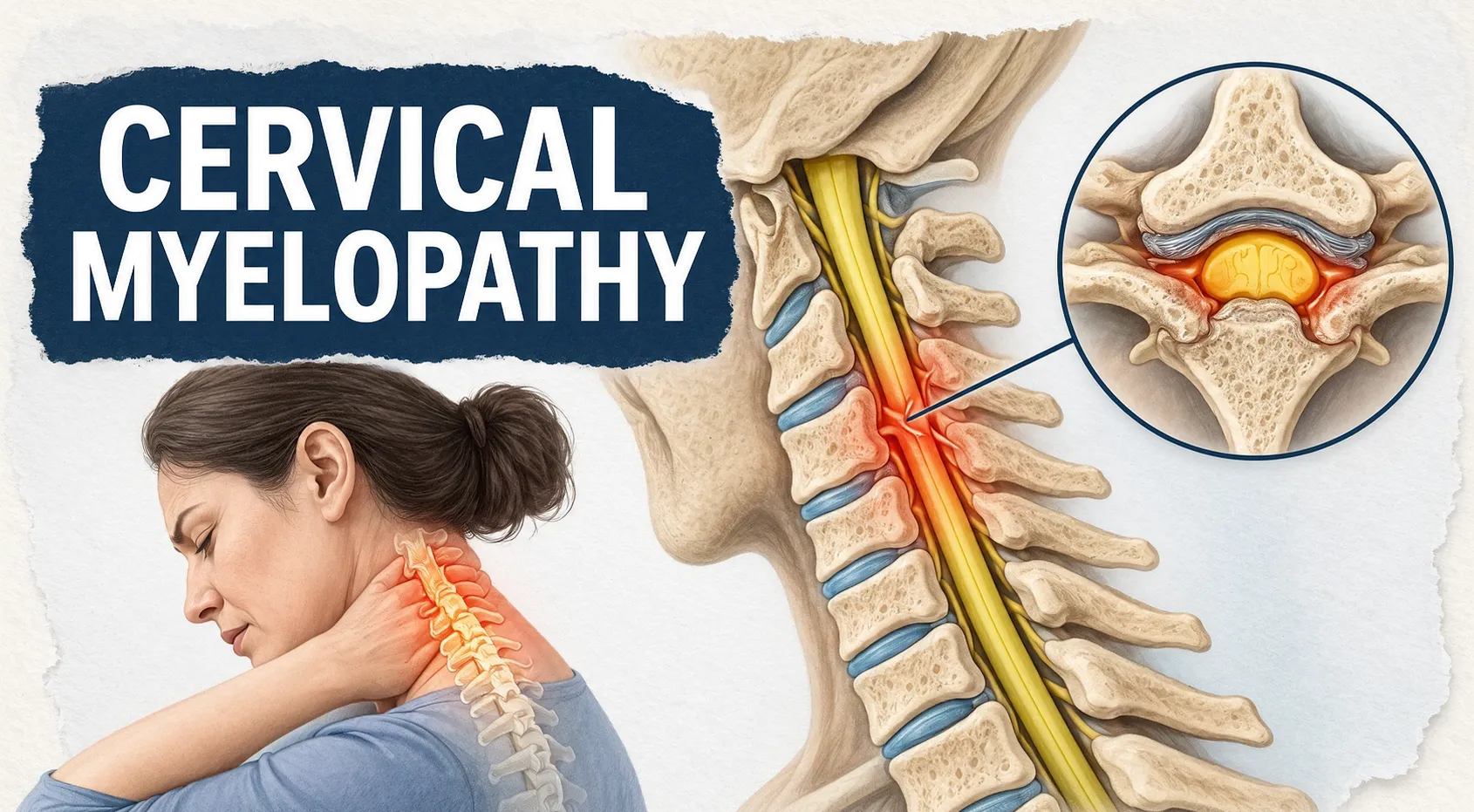

Cervical myelopathy is a condition in which the spinal cord in the neck is affected, most commonly by compression from degenerative changes in the cervical spine
Degenerative cervical myelopathy (DCM) is the term used when age-related changes in the discs, joints, bones or ligaments cause dysfunction of the spinal cord.
Because the spinal cord carries signals between the brain and the rest of the body, pressure on it can affect the hands, the legs, balance and, in some cases, bladder and bowel control. Symptoms often develop slowly and are easy to put down to age or to a problem in the hands, so the condition can go unrecognised for some time. This article explains what cervical myelopathy is, its symptoms and causes, how it is diagnosed, and the treatment options.
What Is Cervical Myelopathy?
The spinal cord runs from the brain down through a bony channel in the spine called the spinal canal. In the neck (the cervical spine), this canal can become narrowed. When the narrowing is enough to press on the cord, the result is called cervical myelopathy.
This is different from a “pinched nerve” in the neck (cervical radiculopathy). In radiculopathy, a nerve root leaving the spine is irritated, which usually causes pain, tingling or weakness in one arm. In myelopathy, the spinal cord itself is affected, which can cause symptoms in both hands and in the legs. The two can occur together. See arm pain (cervical radiculopathy) for more on nerve root problems.
The most common form is called degenerative cervical myelopathy, caused by age-related wear in the spine.
Symptoms of Cervical Myelopathy
Symptoms vary from person to person and often progress gradually. In some people, they stay stable for long periods, while in others they can worsen in steps or more rapidly.
Hand and Arm Symptoms
Numbness or tingling in one or both hands
Clumsiness or loss of dexterity
Difficulty with fine tasks such as fastening buttons, writing, using a phone or picking up small objects
Dropping things
Weakness in the hands or arms
Walking and Balance Symptoms
- Unsteadiness or a feeling of imbalance
- Stiff or heavy legs
- Difficulty walking in a straight line, going down stairs or walking in the dark
- Falls or near-falls
Other Symptoms
- Neck pain or stiffness (this is not always present)
- An electric-shock sensation running down the spine or into the limbs when the neck is bent forward (known as Lhermitte’s sign)
- Urinary urgency, frequency or difficulty controlling the bladder, and less commonly bowel changes, usually in more advanced cases
Because hand numbness and clumsiness can have other causes, such as carpal tunnel syndrome, the combination of hand symptoms with walking or balance changes is one reason for further assessment.
What Causes Cervical Myelopathy?
Age-Related (Degenerative) Changes
Most cases are due to degenerative change in the neck. Several changes can contribute, and they often occur together:
Disc degeneration and bulging. Discs lose height and may bulge backwards into the canal. See cervical disc prolapse.
Bone spurs (osteophytes). Extra bone can form around the discs and joints as the spine wears.
Thickening of ligaments. The ligaments inside the canal can thicken or buckle, reducing the space for the cord.
Joint arthritis. Enlargement of the small joints at the back of the spine can add to the narrowing.
Slipped vertebrae (listhesis). One vertebra can move forward over another in the neck.
A Naturally Narrow Spinal Canal
Some people are born with a canal that is narrower than average, so they have less spare room and may develop symptoms with less degenerative change.
Ossification of the Posterior Longitudinal Ligament (OPLL)
In this condition, a ligament running along the back of the vertebrae gradually turns to bone and can narrow the canal. It is more commonly reported in East Asian populations but occurs worldwide.
Other Causes
Less commonly, myelopathy can result from injury, inflammatory arthritis affecting the neck, infection, tumours, or other conditions that compress the cord.
Although degenerative cervical myelopathy (DCM) is the most common compressive cause in adults, several non-compressive, inflammatory, metabolic, vascular and infectious conditions can produce similar neurological findings.
Who Is at Risk?
Cervical myelopathy is most often diagnosed in people over 50, and the risk rises with age. Other factors that may be associated with it include a congenitally narrow canal, degenerative changes and conditions like ossified posterior longitudinal ligament.
Warning Signs: When to Seek Urgent Medical Help
Seek urgent assessment (contact your GP the same day, call NHS 111, or attend A&E, depending on severity) if you have:
- Rapidly worsening weakness, numbness or clumsiness in the arms or legs
- New difficulty walking, or repeated falls
- Loss of bladder or bowel control, or new difficulty passing urine
- Numbness around the genitals or buttocks
- New neck symptoms following an injury such as a fall or road traffic collision
- Seek urgent medical assessment if you develop new or worsening hand weakness, loss of coordination, difficulty walking or repeated falls.
- Sudden weakness, paralysis or rapidly developing neurological symptoms require emergency assessment, as other serious conditions, including stroke, may also cause these symptoms. Call 999 for sudden stroke-like symptoms, severe neurological deterioration or suspected serious spinal injury.
- New bladder or bowel dysfunction associated with neurological symptoms requires urgent assessment.
How Is Cervical Myelopathy Diagnosed?
History and Examination
The assessment begins with a detailed history of when symptoms began and how they have changed. The examination typically includes testing of strength, sensation, reflexes, hand function, balance and walking. Signs that suggest spinal cord involvement include brisk reflexes, abnormal reflex responses in the hands or feet, and difficulty with tandem (heel-to-toe) walking.
MRI Scan
MRI is the main investigation. It shows the spinal cord, discs, ligaments and the degree of canal narrowing, and can show whether there are changes within the cord itself.
However, spinal cord compression on MRI does not automatically mean that a person has clinical myelopathy. Some individuals have cervical cord compression without neurological symptoms or signs.
The diagnosis of DCM requires correlation between the clinical history, neurological examination and imaging findings.
Changes in spinal cord signal on MRI may provide additional information about cord injury, but they should not be interpreted in isolation when deciding treatment.
Other Tests
X-rays show alignment, bone changes and movement of the vertebrae.
CT scans show bone detail and are used, for example, if OPLL is suspected or when planning surgery.
Nerve conduction studies may be used when other conditions, such as carpal tunnel syndrome or peripheral neuropathy, need to be distinguished.
Blood tests may be done to rule out other conditions that can cause similar symptoms, such as vitamin B12 deficiency.
Conditions That Can Look Similar
Carpal tunnel syndrome, peripheral neuropathy, vitamin B12 deficiency, multiple sclerosis, motor neurone disease, and other causes of balance problems can share some features, which is why a specialist assessment and imaging are important.
Treatment Options for Cervical Myelopathy
Treatment depends on the severity of symptoms, how quickly they are changing, and the findings on the scan.
Monitoring (Non-Surgical Management)
For people with very mild, clinically stable symptoms, or those who are not suitable for surgery, regular clinical review may be recommended. This involves follow-up to watch for any change, along with advice on:
Reporting any new or worsening hand, walking or bladder symptoms promptly
Reducing the risk of falls
Avoiding activities with a risk of neck injury
There is no medication or exercise that has been shown to reverse compression of the spinal cord.
For selected patients with mild DCM, either surgical treatment or a supervised trial of structured rehabilitation may be appropriate. Patients managed without surgery should be monitored for neurological deterioration.
If neurological function worsens, surgical treatment should be reconsidered promptly. Surgery may also be considered if symptoms fail to improve with an appropriate non-operative approach.
Surgery
Surgical decompression is generally recommended for patients with moderate or severe degenerative cervical myelopathy.
For mild DCM, surgery or supervised structured rehabilitation may be considered following discussion of the benefits, risks and uncertainty of each approach.
Progressive neurological deterioration is an important indication for surgical assessment, regardless of the initial severity classification.
The aim is to create more space for the spinal cord (decompression) and to help prevent further deterioration.
Surgery may also improve hand function, walking, balance and quality of life. However, the degree of recovery varies, and longstanding neurological deficits may not fully resolve.
Earlier treatment, before substantial neurological deterioration, may offer a better opportunity for functional recovery, although individual outcomes cannot be guaranteed.
The type of operation depends on how many levels are affected, the alignment of the neck, and where the compression is coming from. Options include:
- Anterior cervical discectomy, with fusion. Approached from the front of the neck, the disc is removed, and the space is typically stabilised. See cervical discectomy.
- Cervical corpectomy. Removal of part of a vertebral body (and adjacent discs) from the front, when compression extends behind the bone.
- Cervical laminectomy, with or without fusion. Approached from the back of the neck, part of the bony arch of the vertebra is removed to open the canal. See cervical laminectomy.
- Laminoplasty. Another approach from the back that widens the canal while keeping the back of the spine in place.
Risks of Surgery
As with any operation, there are general risks such as bleeding, infection, anaesthetic complications and blood clots. Risks specific to cervical spine surgery can include temporary difficulty swallowing or hoarseness after a front-of-neck approach, injury to the spinal cord or nerves, leakage of spinal fluid, neck pain or stiffness, and problems with fusion or adjacent levels over time. A surgeon will explain the risks and benefits relevant to you before you decide.
Some patients may develop new weakness in the shoulder or upper arm after cervical decompression, known as C5 palsy. This is a recognised complication, particularly after certain posterior cervical procedures. Recovery varies and may take months; occasionally weakness persists.
Recovery
Recovery depends on the operation. Most people stay in hospital for a short period, and gradual return to activity is guided by the surgical team and often supported by physiotherapy.
Some symptoms may improve over weeks to months, while others may be slow to change or may persist.
Neurological recovery can continue over several months following decompression. However, the extent of improvement depends on factors such as preoperative severity, duration of symptoms and individual patient characteristics.
Surgery cannot guarantee reversal of established spinal cord injury.
When Should You See a Spine Specialist?
Consider seeking an assessment if:
- You have numbness, tingling or clumsiness in both hands
- You notice new unsteadiness, stiffness in the legs or changes in the way you walk
- You have been told that your MRI shows narrowing of the spinal canal or compression of the cord in the neck
- You have neck symptoms along with changes in the hands or legs
- You are unsure whether your symptoms relate to the neck
Mr Prasad Karpe is a consultant spine surgeon who assesses neck conditions in adults. You can read more about cervical disc myelopathy and neck pain, or contact the clinic to arrange a consultation.
Frequently Asked Questions
What does an MRI show in cervical myelopathy?
It shows the shape of the spinal canal, how much the cord is compressed, which discs, bone or ligaments are responsible, and whether there are changes inside the cord.
Can physiotherapy treat cervical myelopathy?
Physiotherapy cannot remove compression of the spinal cord, but it may be used to support strength, balance and function. Neck manipulation is usually avoided.
Is cervical myelopathy always treated with surgery?
No. Mild, stable symptoms may be monitored. Surgery is generally considered for moderate to severe symptoms or when symptoms are getting worse.
Can cervical myelopathy affect the bladder?
In some people, particularly in more advanced cases, it can cause urgency, frequency or difficulty controlling the bladder. New bladder symptoms with neck or limb symptoms should be assessed promptly.
References
- Fehlings MG et al. (2017).A Clinical Practice Guideline for the Management of Patients With Degenerative Cervical Myelopathy: Recommendations for Patients With Mild, Moderate, and Severe Disease and Nonmyelopathic Patients With Evidence of Cord Compression. Global Spine Journal, 7(3 Suppl), 70S–83S. Clinical practice guideline
- Davies BM et al. (2018).Degenerative cervical myelopathy. BMJ, 360, k186. BMJ clinical review
- Tetreault L et al. (2017).A Clinical Practice Guideline for the Management of Patients With Degenerative Cervical Myelopathy: Introduction, Rationale, and Scope. Global Spine Journal, 7(3 Suppl), 21S–27S. Guideline background
Disclaimer
This article is for general information only and does not replace medical advice. If you are concerned about your symptoms, speak to a healthcare professional.