
Stages of Disc Degeneration: Understanding How Spinal Discs Change Over Time

The discs in your spine act as natural shock absorbers, helping you bend, twist, and move comfortably. As we age, these discs gradually lose water content and elasticity, a process known as disc degeneration. While this is a normal part of aging, it can sometimes lead to back pain, stiffness, nerve irritation, or reduced mobility.
Understanding the 4 stages of disc degeneration can help you recognise how the condition progresses, what symptoms may occur at each stage, and when medical assessment may be appropriate. Not everyone with disc degeneration experiences pain, and many people manage their symptoms successfully with conservative treatment.
This guide explains each stage of disc degeneration, its causes, symptoms, diagnosis, treatment options, and when to seek medical advice.
What Is Disc Degeneration?
Intervertebral discs sit between the bones (vertebrae) of the spine. Each disc has:
- A tough outer layer called the annulus fibrosus
- A soft, gel-like centre called the nucleus pulposus
These discs absorb shock, maintain flexibility, and prevent the vertebrae from rubbing together.
Over time, discs naturally lose water and become less flexible. This process is known as degenerative disc disease or disc degeneration. Although the term “disease” is commonly used, it often reflects age-related changes rather than an illness. To understand how the lower back supports movement and absorbs pressure, read What Does the Lumbar Spine Do?
What Are the Stages of Disc Degeneration?
Disc degeneration describes gradual changes that can occur within the intervertebral discs over time.
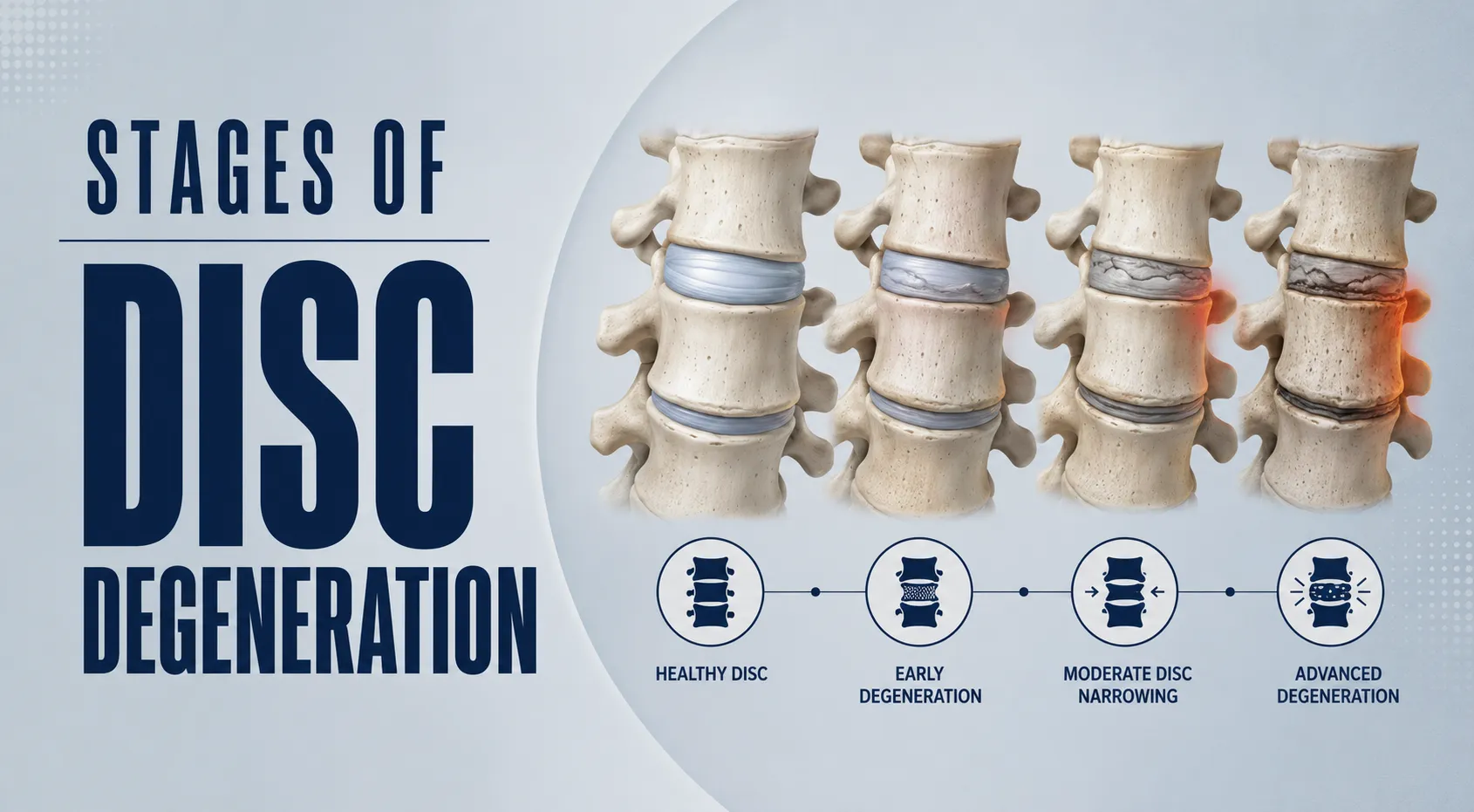
There is no single universally accepted four-stage classification of disc degeneration. However, for simplicity, the changes can be described as progressing from early disc changes to more advanced degeneration.
Importantly, these changes do not always progress in a predictable sequence, and the appearance of a disc on an MRI does not necessarily determine whether someone will experience pain.
Stage 1 – Early Disc Changes
Early degeneration may involve:
- Reduced water content within the disc
- Small fissures within the outer annulus
- Changes in the internal structure of the disc
- Early changes in MRI appearance
Disc height is often relatively well preserved.
Many people have no symptoms at this stage.
Stage 2 – Progressive Disc Degeneration
As degenerative changes progress:
- The disc may lose further hydration
- The distinction between the nucleus and annulus may become less clear
- Disc height may begin to reduce
- The mechanical properties of the disc can change
These changes become increasingly common with age and do not necessarily cause back pain.
Stage 3 – Disc Height Loss and Associated Changes
Further degeneration may be associated with:
- Greater loss of disc height
- Osteophyte (bone spur) formation
- Changes in the facet joints
- Changes in the surrounding spinal structures
In some people, these changes can contribute to narrowing around the spinal canal or nerve roots.
However, the severity of these changes on imaging does not necessarily reflect the severity of symptoms.
Stage 4 – Advanced Degenerative Changes
More advanced degeneration may include:
- Significant loss of disc height
- Marked loss of normal disc signal on MRI
- Osteophyte formation
- Facet joint degeneration
- Foraminal or spinal canal narrowing
If these changes result in nerve compression, symptoms may include radiating arm or leg pain, numbness, tingling or weakness, depending on which part of the spine and which nerve is affected.
Some people with advanced degenerative changes have few or no symptoms.
Does Disc Degeneration Always Cause Pain?
No, Degenerative changes are commonly found on MRI scans, including in people without back pain. For this reason, an MRI should not be interpreted in isolation.
The important question isn’t simply how much degeneration is present — it’s whether the imaging findings correspond with your symptoms and clinical examination.
What Causes Disc Degeneration?
Several factors contribute to disc degeneration.
These include:
- Natural ageing
- Repetitive heavy lifting
- Previous spinal injuries
- Smoking
- Excess body weight
- Physically demanding occupations
- Genetic factors
- Sedentary lifestyle
Age remains the strongest factor.
Common Symptoms
Persistent back pain can have many causes. Our guide on 5 Causes of Lower Back Pain explains some of the most common conditions affecting the spine.
Common symptoms include:
- Neck or back pain
- Stiffness
- Reduced flexibility
- Pain after sitting for long periods
- Pain during bending or lifting
- Muscle spasms
- Pain travelling into the arms or legs
- Tingling or numbness
- Weakness in severe cases
Can Disc Degeneration Cause Nerve Compression?
Yes. As discs lose height, surrounding structures may place pressure on nearby nerves. As discs deteriorate, they may bulge and irritate nearby nerves. Learn more in L5 S1 Disc Bulge Symptoms.
This can lead to:
- Sciatica
- Arm pain
- Tingling
- Numbness
- Muscle weakness
Not everyone with disc degeneration develops nerve compression.
How Is Disc Degeneration Diagnosed?
Diagnosis begins with a medical history and physical examination.
Your clinician may assess:
- Pain patterns
- Mobility
- Muscle strength
- Reflexes
- Sensation
Imaging may include:
MRI Scan
MRI is the preferred investigation because it clearly shows the discs, nerves, and soft tissues.
X-rays
X-rays may demonstrate reduced disc height and bone spurs.
CT Scan
CT scans are sometimes used to assess bony changes in greater detail.
Treatment Options
Treatment depends on symptom severity rather than imaging findings alone. Most patients need no treatment at all.
Conservative Management
Most people improve without surgery.
Management may include:
Physiotherapy
Exercise
Pain relief medication
Weight management
Activity modification
Postural advice
Physiotherapy
Exercise programmes often focus on:
Core strengthening
Flexibility
Mobility
Postural correction
Functional movement
Spinal Injections
Some patients with persistent nerve pain may benefit from injections. Read Do I Need an Injection for a Prolapsed Lumbar Disc? to learn when they may be appropriate.
Surgery
Surgery is usually considered only when:
Conservative treatment has not helped
Significant nerve compression is present
Weakness develops
Symptoms significantly affect quality of life
The type of surgery depends on the underlying spinal condition.
Can Disc Degeneration Be Prevented?
There is no guaranteed way to prevent spinal cancer.
However, early investigation of persistent or unexplained back pain—particularly when accompanied by neurological symptoms or a previous history of cancer—can help identify serious conditions sooner.
When Should You See a Specialist?
Arrange an appointment if:
- Back pain lasts longer than six weeks
- Pain spreads into the arms or legs
- Numbness develops
- Weakness occurs
- Symptoms continue to worsen
- Daily activities become difficult
Prompt assessment can help identify whether symptoms are due to disc degeneration or another spinal condition.
Conclusion
Disc degeneration is a common age-related process that affects many adults, but it does not always cause pain or disability. Understanding the four stages of disc degeneration can help you recognise symptoms, make informed decisions about treatment, and seek medical advice when appropriate.
Most people benefit from conservative measures such as exercise, physiotherapy, and lifestyle modifications. If symptoms persist or neurological problems develop, further assessment by a spinal specialist may be recommended.
If you are experiencing persistent back or neck pain, stiffness, or symptoms that may be related to disc degeneration, an assessment by a qualified spinal specialist can help determine the cause and discuss appropriate treatment options based on your individual needs.
Disclaimer
This article is for general information only and does not replace professional medical advice. If you have concerns about your symptoms, please consult a qualified healthcare professional.