
Stress Fracture in the Back: Symptoms, Causes, Diagnosis and Treatment
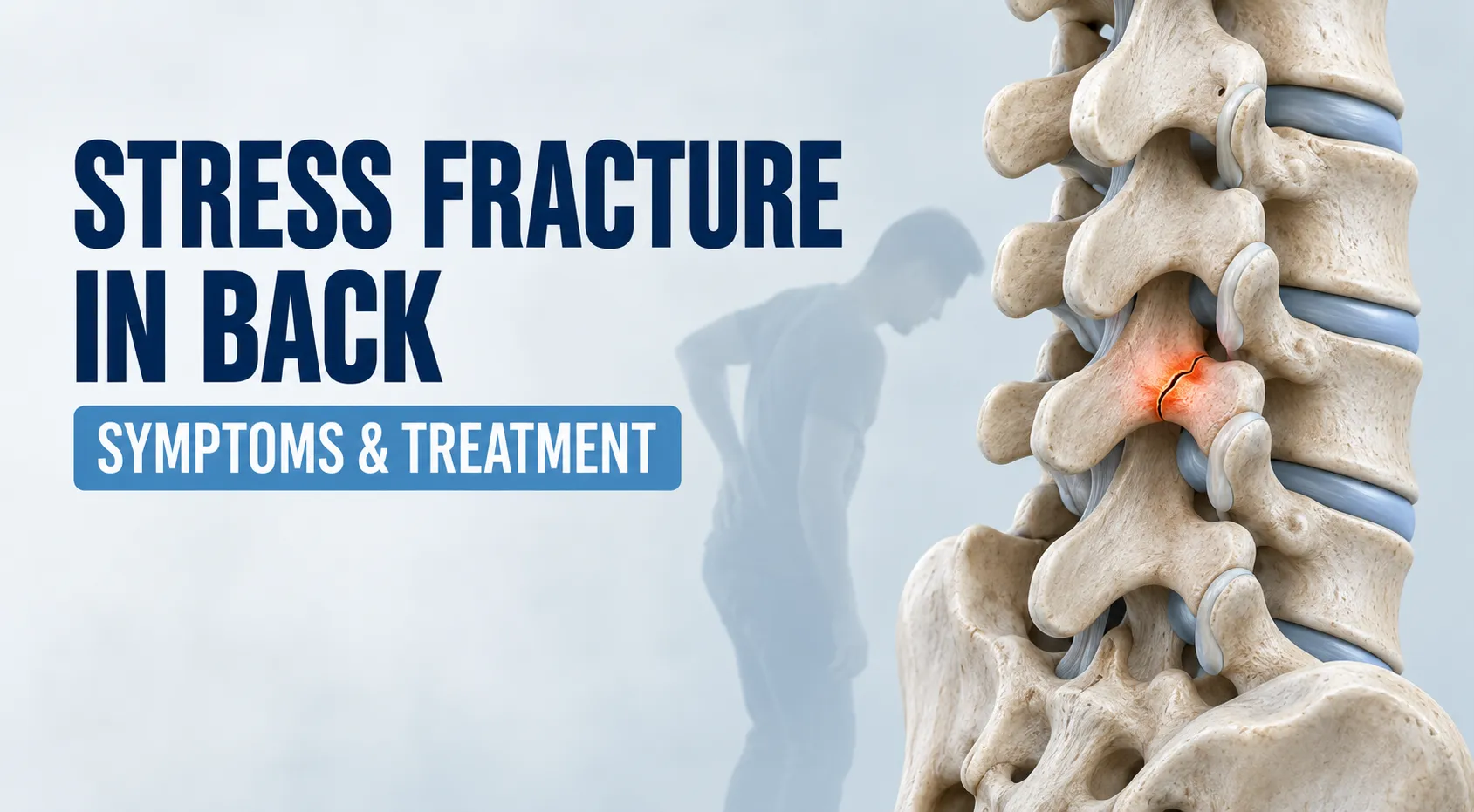

A stress fracture in the back is a type of bone injury that develops when repeated loading or stress on the spine exceeds the bone’s ability to repair itself. Unlike a fracture caused by a single major accident, a stress fracture can develop gradually, with pain often becoming noticeable during or after physical activity.
Stress fractures can affect different parts of the spine. In athletes and physically active people, one commonly discussed area is the pars interarticularis, a small section of bone in the posterior part of a vertebra. A stress injury in this area is called a pars stress injury, and if the bone develops a complete fracture, it may be referred to as spondylolysis.
Recognising symptoms and getting an appropriate assessment can help determine the cause of back pain and whether you need to modify activity.
What Is a Stress Fracture in the Back?
A stress fracture is a small crack or area of bone damage caused by repeated mechanical stress.
Bones are constantly breaking down and repairing themselves. When repetitive loading exceeds the bone’s ability to recover, a stress injury can develop.
In the spine, stress injuries can occur in different locations. A particularly recognised type is a stress injury involving the pars interarticularis, which connects parts of the vertebral arch.
A stress injury may develop before a complete fracture occurs. This is why early assessment matters when activity-related back pain persists.
A spinal stress fracture is different from a typical acute traumatic fracture and should not automatically be considered the same as a vertebral compression fracture.
What Causes a Stress Fracture in the Back?
Stress fractures develop through repeated loading rather than necessarily one specific injury.
Activities involving repetitive spinal extension, rotation or loading can increase stress on parts of the spine. This can be particularly relevant in sports that repeatedly place the lower back under load.
Potential contributing factors include:
- Repetitive high-impact activity
- Repeated back extension
- Repetitive twisting or rotation
- Sudden increases in training volume or intensity
- Poor recovery between demanding activities
- Reduced bone strength
- Previous stress injury
- Certain sporting techniques or training patterns
However, the presence of one of these factors does not mean that a person will have a stress fracture. Back pain has many possible causes, and clinical assessment is needed to establish the underlying problem.
Who Is at Risk of a Stress Fracture in the Back?
Stress injuries can occur in people who participate in physically demanding activities, particularly when the spine is repeatedly exposed to loading.
They can be seen in athletes involved in sports that require frequent spinal extension and rotation.
The risk may also increase when someone suddenly changes their activity level. For example, rapidly increasing training frequency, intensity or duration without adequate progression can place additional stress on the musculoskeletal system.
Bone health can also influence susceptibility to stress injuries. If a fracture occurs with relatively little loading or there are other reasons to suspect reduced bone strength, further medical assessment may be appropriate.
Stress Fracture in the Back Symptoms
The symptoms of a spinal stress fracture can vary depending on its location and severity.
A common feature is back pain that is related to physical activity.
Symptoms may include:
- Localised lower back pain
- Pain that becomes worse with activity
- Pain during repeated back extension
- Pain associated with twisting or loading
- Stiffness in the lower back
- Reduced ability to participate in sport or exercise
In some cases, the pain may initially settle with rest and return when the activity is resumed.
This pattern can make a stress injury difficult to recognize, particularly if the person assumes that the discomfort is simply muscular.
What Does a Stress Fracture in the Back Feel Like?
Stress fracture pain is often described as a localised ache in the lower back, especially during activities that repeatedly stress the affected area.
The pain may initially be noticeable only during exercise. If the underlying stress continues, symptoms can become more persistent.
Pain associated with a stress injury is not necessarily identical in every person. The location and character of pain depend on the structure involved.
Importantly, lower back pain alone cannot confirm a stress fracture. Muscle, disc, joint and other spinal conditions can produce similar symptoms.
Can a Stress Fracture Cause Leg Pain?
A stress fracture involving the posterior elements of the spine does not automatically cause nerve-related leg pain.
Symptoms such as significant pain travelling down the leg, numbness, tingling or weakness can suggest involvement of a spinal nerve or another condition affecting the lower back.
If back pain is accompanied by new neurological symptoms, seek professional assessment.
Stress Fracture vs Muscle Strain
A stress fracture can initially resemble a muscle strain because both can cause activity-related back pain.
A muscle strain involves injury to muscle or associated soft tissues, whereas a stress fracture involves bone.
The distinction cannot reliably be made based on symptoms alone.
Persistent pain that repeatedly returns with activity, particularly when there has been a change in training or repetitive spinal loading, may warrant assessment rather than repeated self-treatment as a presumed muscle strain.
How Is a Stress Fracture in the Back Diagnosed?
Diagnosis begins with a clinical assessment.
A healthcare professional may ask about:
- When the pain started
- Whether there was a specific injury
- Changes in exercise or training
- Activities that make the pain worse
- Previous injuries
- Other symptoms
- Your general health and bone health
A physical examination may assess spinal movement, areas of tenderness, neurological function and other findings relevant to the symptoms.
Imaging for a Stress Fracture
Imaging may be required when a stress fracture or pars stress injury is suspected.
The most appropriate imaging depends on the clinical situation and the suspected location of the injury.
Possible investigations can include:
- X-rays
- MRI
- CT scans
- Other imaging when clinically appropriate
MRI can provide information about bone marrow changes associated with stress injury, while CT can provide detailed information about bony anatomy and an established fracture.
The choice of imaging should be determined by the clinician based on the individual’s symptoms and examination.
Treatment for a Stress Fracture in the Back
Treatment depends on the location and severity of the stress injury, the person’s symptoms, activity requirements and whether there is an established fracture.
For many stress injuries, an important part of treatment is reducing or temporarily modifying the activity that is placing repeated stress on the affected area.
Treatment may involve:
- Activity modification
- Gradual return to activity
- Physiotherapy
- Strength and conditioning
- Pain management where appropriate
- Monitoring symptoms and recovery
- Further treatment when symptoms persist or structural problems require it
The objective is not simply to stop all physical activity indefinitely. Instead, activity is generally adjusted to allow recovery while maintaining appropriate physical function.
Activity Modification
Activity modification is often an important part of managing a stress injury.
This may mean temporarily reducing or avoiding activities that reproduce the pain, particularly repetitive extension, impact or heavy spinal loading.
The appropriate restrictions vary between individuals.
A person should not assume that complete bed rest is necessary unless specifically advised by their healthcare professional. Prolonged inactivity can result in loss of strength and conditioning.
The return to activity should be gradual and guided by symptoms and clinical advice.
Physiotherapy for a Stress Fracture
Physiotherapy can play a role in rehabilitation once the appropriate stage of recovery has been established.
A physiotherapy programme may focus on:
- Restoring comfortable movement
- Improving trunk and core strength
- Developing appropriate hip and lower-limb strength
- Improving movement control
- Gradually increasing physical capacity
- Preparing for a return to sport or other demanding activities
Exercises should be selected according to the individual rather than following a generic programme found online.
If a particular movement consistently reproduces pain, it should be discussed with the healthcare professional overseeing rehabilitation.
Returning to Sport After a Stress Fracture
Returning to sport too quickly can place the healing area under stress again.
A staged return is generally preferable to suddenly resuming full training.
Progression can involve gradually increasing activity while monitoring symptoms and physical function.
The exact process depends on the injury, sport and individual circumstances. An athlete involved in repetitive extension or rotation may require a different rehabilitation approach from someone whose normal activities involve less spinal loading.
If pain returns as activity increases, the progression may need to be reassessed.
Can a Stress Fracture Heal Without Surgery?
Stress fractures can be managed without surgery, particularly when identified early and treated with appropriate activity modification and rehabilitation.
However, the outcome depends on the type and stage of the injury.
An established fracture, persistent symptoms or associated structural problems may require further assessment by a spinal specialist.
Therefore, don’t assume every stress fracture will follow the same course.
When Is Surgery Considered?
Surgery is not automatically required for a stress fracture in the back.
If symptoms persist despite appropriate non-surgical treatment, or if there is a structural problem that requires surgical management, a spinal specialist may discuss whether an operation is appropriate.
The decision depends on factors such as:
- The location and characteristics of the fracture
- Symptoms and their duration
- Response to non-surgical treatment
- Spinal stability
- Associated spinal conditions
- The person’s age, activity requirements and overall health
The most appropriate treatment should be determined following individual clinical assessment.
How Long Does a Stress Fracture in the Back Take to Heal?
There is no single healing time that applies to every spinal stress fracture.
Recovery depends on factors including:
- The location of the injury
- Whether it is an early stress reaction or established fracture
- The extent of bone involvement
- Bone health
- Activity levels
- Treatment and rehabilitation
- Whether symptoms improve with activity modification
Returning to high-impact or high-load activity before adequate recovery can cause symptoms to recur.
Your clinician or physiotherapist can provide more specific guidance based on the nature of the injury and your progress.
How Can Stress Fractures Be Prevented?
Not every stress fracture can be prevented, but managing training load and allowing adequate recovery can help reduce avoidable stresses on the musculoskeletal system.
Useful principles include:
- Increase training gradually rather than suddenly
- Allow appropriate recovery between demanding sessions
- Avoid repeatedly training through significant pain
- Maintain appropriate strength and conditioning
- Use suitable sporting technique
- Pay attention to persistent or recurring pain
- Address factors that may affect bone health
For athletes, training programmes should account for changes in volume, intensity, and recovery rather than increasing several factors at once.
If stress fractures occur repeatedly, medical assessment may be appropriate to investigate possible contributing factors.
When Should You See a Doctor About Back Pain?
Back pain after exercise is common and does not necessarily indicate a stress fracture.
However, medical assessment is appropriate when pain:
- Persists despite reducing the aggravating activity
- Repeatedly returns when activity resumes
- Is progressively worsening
- Prevents normal exercise or daily activities
- Develops after a significant injury
- Is associated with numbness, tingling or weakness
- Is accompanied by changes in bladder or bowel control
Urgent medical assessment is particularly important if back pain is accompanied by new significant weakness in the legs, loss of bladder or bowel control, or numbness around the genital or anal area.
Stress Fracture in the Back: Key Points
A stress fracture in the back is a bone stress injury that can develop through repeated loading rather than one major traumatic event.
Key points to remember include:
- Stress injuries can develop gradually.
- The pars interarticularis is one area of the spine where stress injuries can occur.
- Activity-related lower back pain can have many different causes.
- Persistent or recurring pain should not automatically be assumed to be a muscle strain.
- Imaging may be required when a stress injury is suspected.
- Treatment often involves modifying the activity that aggravates the injury.
- Rehabilitation and a gradual return to activity can form part of recovery.
- Surgery is not automatically required and is considered according to the individual’s clinical circumstances.
- New neurological symptoms require medical assessment.
Conclusion
A stress fracture in the back can develop when repeated loading places more stress on the spine than the affected bone can adequately tolerate and repair.
Symptoms may initially be subtle, especially when pain occurs mainly during exercise and improves with rest. This can make the condition difficult to distinguish from a muscular injury or other causes of back pain.
Early assessment of persistent or recurring activity-related pain can help establish the underlying cause. Treatment depends on the type and severity of the injury and may include activity modification, rehabilitation and a gradual return to normal activities.
If symptoms continue despite appropriate non-surgical management, or if there are neurological symptoms or other concerning features, further assessment by a spinal specialist may be appropriate.
If you have persistent or recurring back pain, particularly pain that affects your ability to work, exercise, or carry out everyday activities, Mr Prasad Karpe, Consultant Spinal Surgeon, can assess your symptoms and determine whether further investigation or treatment is appropriate.
Disclaimer
This article is for informational purposes only and does not replace professional medical advice, diagnosis, or treatment. Disability status and treatment recommendations depend on individual medical assessment and symptom severity.